
 When a commercial truck’s equipment fails on a Houston highway, the results are rarely minor. Brake failures, tire blowouts, steering defects, and unsecured cargo can turn a routine interstate crossing into a devastating collision in seconds.
What makes these crashes different from other truck accidents is where the fault lies: not always with the driver’s actions at the moment of impact, but with decisions made long before the truck ever left the yard.
Trucking companies, maintenance contractors, and manufacturers all have legal obligations to keep equipment roadworthy, and when they fall short, they can be held accountable.
If you or a family member was hurt in a truck accident caused by equipment failure, the skilled Houston truck accident lawyers at Mokaram Injury Lawyers are available 24/7. Call 281-222-2222 or contact us online for a free, no-obligation case review.
What Qualifies as Truck Equipment Failure
 Truck equipment failure covers any mechanical or structural defect that contributes to a crash. This includes failures that happen suddenly during operation, as well as deficiencies that were present before the trip began and never caught or corrected.
Federal law specifies the standards trucks must meet. Under 49 CFR Part 393, all parts and accessories on a commercial motor vehicle must meet minimum safety standards as a condition of operation.
This covers brakes, lighting, tires, coupling devices, steering systems, fuel systems, and cargo securement equipment. A truck that does not meet these standards has no business on the road, and when a carrier puts one there anyway, the consequences fall on everyone who shares that road.
Common Types of Equipment Failures That Cause Truck Accidents
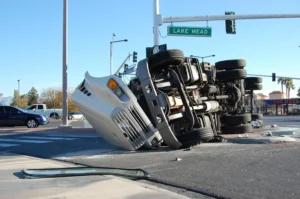 Equipment failures come in several forms, and each one presents differently in how the crash unfolds and where liability lies.
Brake System Failures
Brake system failures are among the most deadly. Commercial trucks rely on air brake systems that require regular inspection, adjustment, and maintenance. When brake components wear beyond their service limits, air lines crack, or adjusters are ignored, a fully loaded 18-wheeler may be unable to stop in time to avoid a collision.
Tire Failures
Tire failures, including blowouts and tread separation, regularly cause trucks to veer across lanes without warning. Tires rated for a specific load range fail at unpredictable times when pushed beyond their limits or run on deteriorating tread. Debris from a tire failure also poses a direct hazard to surrounding vehicles.
Other Failures
Other common failure types include:
- Steering component failures that cause loss of directional control
- Trailer coupling and fifth wheel defects (the mechanism that connects a trailer to the truck cab) that allow trailers to separate from the cab
- Lighting failures that make a truck invisible to other drivers in low-visibility conditions
- Suspension system failures that destabilize a truck’s handling at highway speeds
- Unsecured or improperly loaded cargo that shifts in transit and causes rollovers or road debris
- Defective mirrors or camera systems that eliminate a driver’s visibility of surrounding traffic
Each of these scenarios involves a failure point that should have been caught before the truck left the terminal.
The Federal and Texas Standards Carriers Must Meet
The Federal Motor Carrier Safety Administration (FMCSA) requires trucking carriers to systematically inspect, repair, and maintain every commercial vehicle under their control. Under 49 CFR § 396.3, parts and accessories must be in safe and proper operating condition at all times. This includes frame assemblies, suspension systems, axles, wheels and rims, and steering systems, among others.
Required Documentation
Carriers are also required under 49 CFR Part 396 to maintain detailed maintenance records, document driver vehicle inspection reports, and ensure that any defect flagged during an inspection is repaired before the vehicle is returned to service. Drivers themselves are required to complete pre-trip and post-trip inspections and report defects in writing.
Texas Standards
Texas adds its own layer of requirements under Texas Transportation Code § 547, which governs vehicle equipment standards for commercial vehicles operating on state roads. A truck that fails to meet either federal or state equipment standards at the time of a crash should not have been operating, and that fact is central to establishing liability.
Who Can Be Held Responsible?
One of the most important aspects of truck equipment failure cases is that liability rarely stops at the driver. Depending on the circumstances, multiple parties across the trucking and logistics chain may share responsibility.
Potentially liable parties include:
- The trucking company, if it failed to maintain the vehicle, ignored reported defects, or pressured drivers to operate equipment flagged as unsafe
- Third-party maintenance contractors hired to service the truck, if a repair was performed incorrectly or a known defect was missed
- The manufacturer of a defective component, if the failure resulted from a design or production defect rather than a lack of maintenance
- A loading company or cargo owner, if improperly secured cargo caused a rollover or loss of control
- A leasing company, if it were responsible for the vehicle’s maintenance under the terms of a lease agreement
Texas follows a modified comparative fault rule under Texas Civil Practice and Remedies Code § 33.001, which allows liability to be apportioned among multiple defendants. Identifying every party whose decisions contributed to the failure is one of the most consequential steps in building an equipment failure claim.
Evidence That Makes or Breaks These Cases
Equipment failure cases are built on documentation, and the most important records are often held by the trucking company and its maintenance contractor. Acting quickly to preserve that evidence before it is altered, lost, or destroyed is one of the first things our team does when we take on such a case.
Key evidence in truck accident claims involving truck equipment failure includes:
- Driver vehicle inspection reports showing whether defects were previously logged
- Maintenance and repair records for the specific vehicle involved in the crash
- FMCSA inspection histories and any prior out-of-service orders issued against the carrier
- Electronic logging device data showing the truck’s trip history and operating conditions
- Post-crash inspection reports from law enforcement or independent experts
- Black box data showing speed, braking, and other vehicle inputs at the time of impact
- Manufacturer service bulletins or recall records if a component defect is involved
Trucking companies have legal teams that move fast after a serious accident. Having our Houston truck equipment failure accident attorneys on your side from the beginning ensures that the most important evidence is preserved through formal legal channels.
What Compensation Is Available
A successful equipment failure claim can recover both economic and non-economic damages. The specific amounts depend on the severity of the injuries, the degree of fault attributable to each party, and the quality of documentation supporting your losses.
Economic Damages
Economic damages may include medical expenses from emergency treatment through long-term rehabilitation, future care costs for permanent injuries, lost income during recovery, reduced earning capacity if your injuries affect your ability to work going forward, and vehicle repair or replacement costs.
Non-Economic Damages
Non-economic damages cover pain and suffering, emotional distress, loss of enjoyment of life, and disfigurement or permanent impairment. In cases where a trucking company knowingly puts a defective truck on the road, Texas courts may also award exemplary damages, commonly known as punitive damages, to punish that conduct and deter similar decisions in the future.
Under Texas Civil Practice and Remedies Code § 16.003, you have two years from the date of the accident to file a personal injury lawsuit. Given how quickly evidence in these cases can disappear, waiting significantly reduces your ability to build the strongest possible claim.
Why Clients Choose Our Firm
Equipment failure cases against trucking companies and their insurers are not straightforward. These defendants have resources, legal teams, and established strategies for limiting payouts, including shifting blame to drivers, disputing the cause of the failure, and challenging the link between the defect and your injuries. Our team has spent over 30 years going up against exactly that kind of resistance.
We are available around the clock because the hours and days immediately after a serious truck accident are when the most important decisions get made. Whether you are calling from a hospital room or trying to figure out what to do next, someone from our team will pick up, and you’ll be treated like family from that very first call. We pursue every liable party, not just the most obvious one, and we do not stop building your case until every avenue for recovery has been explored.
Frequently Asked Questions About Houston Truck Equipment Failure Accident Cases
How Do You Know If Your Accident Was Caused by Equipment Failure Rather Than Driver Error?
The two are not always mutually exclusive. A thorough post-crash inspection, a review of maintenance records, and analysis of black box data can establish whether a mechanical defect contributed to the crash. Our team works with independent experts to make that determination early in the case.
Can You Sue a Parts Manufacturer If a Defective Component Caused the Failure?
Yes. Product liability claims against manufacturers focus on whether a component was unreasonably dangerous as designed or built, regardless of whether the carrier properly maintained it. This is a distinct legal theory from negligence, and manufacturer defendants often carry separate insurance coverage, so pursuing both tracks can increase your total recovery.
What Happens If the Trucking Company Destroys or Loses Maintenance Records After a Crash?
If a trucking company alters or destroys maintenance records after a crash, that conduct can itself become evidence of liability. Our attorneys send litigation holds and preservation demand letters immediately. When records are improperly destroyed, Texas courts may allow a spoliation inference, permitting the jury to assume those records would have been unfavorable to the carrier.
What Should You Do Immediately After a Truck Accident Caused by Equipment Failure?
If you suspect equipment failure played a role, try to photograph the truck, trailer, and any visible defects before the vehicle is moved or repaired, and get the names of anyone who witnessed the crash. Reporting what you saw to police, even details that seem minor, helps preserve the record before evidence like brake components or tire debris can be repaired away or discarded.
Talk to Our Team After a Houston Truck Equipment Failure Accident
Equipment failures do not happen by accident. They happen because someone skipped an inspection, ignored a flagged defect, or put cost savings ahead of safety. If that decision costs you or someone you love, our team is prepared to hold the right people accountable.
Mokaram Injury Lawyers has recovered over $1 billion for clients across Texas. There is no upfront cost, and we do not collect attorney fees unless we recover compensation for you, though clients may still be responsible for certain litigation costs. Call 281-222-2222 or contact us online for a free case review with one of our truck-equipment-failure accident lawyers.

They are always committed to supporting the people and standing up for the cause. The staff treats everyone with compassion, especially Milagro, who goes above and beyond to ensure humane and respectful care.
From the moment I called, I felt at ease and that’s largely thanks to Lesly. She was incredibly kind, patient, and professional. It’s often overlooked, but that first interaction really sets the tone, especially when you’re calling about something as stressful and personal as a potential injury case.
had a great experience working with Lesly, who handled my case with professionalism, care, and attention to detail. From the beginning, they made me feel heard and supported, clearly explaining the process and always keeping me informed every step of the way. Their communication was timely and thoughtful, and they truly went above and beyond to make a stressful situation feel more manageable.
I spoke with Lesly over the phone and had such a great experience. She was incredibly helpful, patient, and informative. She took the time to explain everything clearly regarding my case and made sure I understood all my options. It made the process way less stressful. Thank you, Lesly, for your professionalism and kindness!
“I live near the Galleria and recently needed help with a premises case I experienced. Lesly Rodriguez took my information, and the entire process was handled smoothly. I appreciate the professionalism and efficiency!”
Working with Ali J was an excellent experience. He handled everything with professionalism and made the process clear and straightforward. I always felt informed and confident knowing he was representing me. I truly appreciate his expertise and highly recommend him.
Mokaram Injury Lawyers made a difficult situation so much easier to handle. Their team really fought for me and made sure I understood every step along the way. I felt like more than just a case number—they genuinely cared about my outcome. Highly recommend them to anyone in need of a reliable and dedicated injury lawyer in Houston!
If you’ve been injured and need someone to advocate for your rights, Mokaram Injury Lawyers is an exceptional choice. With years of experience specializing in personal injury cases, Mokaram Injury Lawyers offers expert legal counsel with a focus on maximizing compensation for medical bills, lost wages, and pain and suffering. Known for a compassionate approach and a strong record of successful outcomes, Mokaram Injury Lawyers fights hard to ensure justice for clients!


Awards & Honors

















Contact Us Today to Schedule
Your Free Consultation
Fields Marked With An “*” Are Required