
 Being at fault for a car accident in Houston does not automatically mean you lose everything, but it does set off a legal and financial process that requires careful attention. Texas is an at-fault state, which means the driver responsible for a crash bears financial responsibility for the resulting injuries and damages. What that looks like in practice depends on your insurance coverage, the extent of the other party’s losses, and how fault is ultimately assigned.
If you have questions about your situation after a collision, Mokaram Injury Lawyers is available 24/7 to review your case at no cost. Call 281-222-2222 or contact us online to speak with our team.
What “At Fault” Means for You Specifically
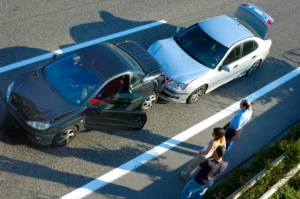 Texas uses a modified comparative fault framework under Texas Civil Practice and Remedies Code § 33.001, and if you caused or contributed to a crash, your assigned percentage of fault determines exactly how much financial liability you have. Being 100% at fault means you are responsible for the full cost of the other party’s damages. Being 60% at fault means you are responsible for 60% of those damages, with the other driver absorbing responsibility for the remaining 40%.
How Fault Is Determined After a Houston Crash
 The fault is not always settled at the scene. In Houston, the process of determining responsibility unfolds across several stages, and the outcome can shift depending on what evidence comes to light.
Initial fault indicators include the police report, which reflects the responding officer’s assessment based on the scene. A police report is not a final legal determination. Insurance adjusters conduct their own investigations, reviewing physical evidence, vehicle damage patterns, traffic camera footage, and witness statements to reach their own conclusions.
Evidence that commonly shapes fault determinations includes:
- The official police report and any citations issued at the scene
- Traffic and surveillance camera footage from nearby intersections or businesses
- Statements from independent witnesses who observed the crash
- Vehicle damage patterns, which can indicate the angle and speed of impact
- Skid marks, debris fields, and road conditions at the collision site
- Cell phone records if distracted driving is alleged
- Event data recorder information from the vehicles involved
If you believe the fault determination is inaccurate or that another party shares responsibility, that argument needs to be supported by evidence. Accepting a fault assignment without reviewing the full picture can have lasting financial consequences.
Why the Fault Percentage Matters
The difference between accepting full fault and challenging your assigned percentage matters more than most at-fault drivers realize. Accepting a full fault assignment without investigating whether the other driver, a road condition, or a third party contributed to the crash can mean paying significantly more than you are legally required to.
The fault percentage is not fixed the moment the police report is written. It can be challenged, adjusted, and contested throughout the claims and litigation process. At-fault drivers who accept early fault assessments at face value often overpay.
Why Houston Car Accident Clients Choose Our Firm
At-fault accident situations are often more complicated than they first appear. Fault percentages get disputed, insurance companies minimize payouts, and the legal process moves quickly. Our team has spent over 30 years handling car accident cases in Houston from every angle, including situations where our clients were partially at fault and needed someone to fight for a fair outcome. Our case results reflect what that approach produces.
Someone is always ready to give you real answers, whether it’s the middle of the day or the middle of the night. We take every case seriously from day one, and the clients we have represented will tell you the same. You can read their testimonials to hear it in their own words.
How Your Insurance Responds
When you are at fault, your liability insurance steps in to pay the other driver’s damages up to your policy limits. What liability insurance covers in this situation includes:
- The other driver’s medical expenses, including emergency care, hospitalization, and follow-up treatment
- Lost wages the other driver missed during recovery
- The other driver’s vehicle repair or replacement
- Pain and suffering damages claimed by the other party
- Legal defense costs and representation if the other driver sues you, up to your policy limits
What liability insurance does not cover matters just as much. It pays nothing toward your own medical bills, your own vehicle repairs, or your passengers’ injuries if you were at fault. Those require separate coverages such as collision, personal injury protection, or medical payments coverage on your own policy.
When Your Coverage Runs Out
This is where at-fault accidents become financially serious for drivers carrying minimum or near-minimum coverage. When the other party’s damages exceed your liability limits, your insurer pays out its maximum and stops. The remaining balance becomes your personal responsibility.
The injured party can pursue a civil judgment against you for that remaining amount. Once that happens, the injured party, now called a judgment creditor, can pursue:
- Garnishment of non-exempt wages
- Liens against non-exempt real property
- Levy on bank accounts and non-exempt assets
Texas law does provide some protections, including the homestead exemption for a primary residence and protections for certain retirement accounts. But those protections have limits, and a serious accident involving catastrophic injuries, surgery, or long-term care can produce damages that reach well beyond them. This is the real-world cost of carrying minimum coverage on Houston’s high-traffic roads.
What to Do After an At-Fault Accident: Steps Specific to Your Situation
The steps an at-fault driver needs to take differ from the general post-accident checklist in important ways. Your insurance company, the other driver’s insurer, and potentially their attorney are all focused on the same target: your policy and your assets. How you communicate in the hours and days after the crash matters.
- Notify your own insurance company promptly, as most policies require timely reporting, and failure to report can complicate your defense.
- Do not give a recorded statement to the other driver’s insurance company without consulting an attorney first. Their adjuster’s job is to build the strongest claim against your policy, and casual statements can be used to support that goal.
- Avoid discussing the accident on social media or with anyone other than your insurer and your attorney.
- Preserve any evidence that supports a shared-fault argument, including dashcam footage, photos of road conditions, or witness contact information.
- Review your policy carefully to understand your actual coverage limits before the other party’s damages are finalized.
- If you receive notice of a lawsuit, contact your insurer immediately, as your policy obligates them to provide legal defense within your coverage limits.
Your Obligations Under Texas Law
Texas law imposes specific requirements on all drivers involved in an accident, regardless of who caused it. Under Texas Transportation Code § 550.023, you are required to provide your name, address, vehicle registration number, and insurance information to the other driver and to any injured parties at the scene. Leaving the scene of an accident that caused injury or property damage is a separate criminal offense that compounds an already serious situation.
Can You Still Recover Anything If You Were Partially at Fault?
Yes, under specific conditions. Texas’s modified comparative fault rule allows a driver who contributed to a crash to recover compensation for their own injuries as long as their share of fault does not exceed 50%. If you were 40% responsible and suffered $100,000 in damages, you could potentially recover $60,000 from the party whose negligence contributed the remaining 60%.
This applies in situations where another driver, a municipality with a poorly maintained road, a vehicle manufacturer with a defective component, or another third party shares responsibility. Just because you contributed to an accident does not mean other contributing factors are irrelevant to your own recovery.
Frequently Asked Questions About Fault in Houston Car Accident Cases
Will Your Insurance Rates Go Up If You Are at Fault for an Accident in Houston?
Most likely yes. Texas insurers may increase premiums after an at-fault accident. The amount of the increase depends on your carrier, your prior driving history, and the severity of the crash. Some policies include accident forgiveness provisions that limit rate increases for a first offense.
What If Both Drivers Claim the Other Was at Fault?
This is common, and it is exactly the situation that insurance adjusters and courts are designed to resolve. Each side presents evidence, and fault is apportioned based on what the investigation supports. Having documentation from the scene strengthens your position in a disputed liability situation.
What If a Road Defect or Traffic Signal Failure Also Contributed to the Crash?
A government entity responsible for road maintenance or traffic signal operation can share liability for a crash even when a driver also contributed. Claims against government entities in Texas involve specific notice requirements and shorter deadlines than standard personal injury claims. Getting legal guidance quickly is important if road conditions played a role in the accident.
Does Texas Require Drivers to Carry Uninsured Motorist Coverage?
Texas does not require drivers to carry uninsured/underinsured motorist (UM/UIM) coverage, but insurers must offer it. If you were at fault and the other driver has UM/UIM coverage, that coverage may factor into how their insurer pursues recovery. If you were partially at fault and the other driver carried no insurance, your own UM/UIM coverage, if you purchased it, could affect your recovery options. Reviewing your full policy after any accident is worth the time.
How Long Do You Have to File a Car Accident Claim in Texas?
Texas generally gives you two years from the date of the crash to file a personal injury lawsuit, under Texas Civil Practice and Remedies Code § 16.003. This deadline applies whether you were at fault, partially at fault, or not at fault at all, so it’s worth speaking with an attorney well before it approaches, since evidence and witness memories fade over time.
Can Fault Be Split Between More Than Two Drivers in a Multi-Vehicle Accident?
Yes. Texas’s comparative fault system isn’t limited to two-party crashes. In a multi-vehicle pileup, an adjuster or jury can assign a percentage of fault to each driver involved based on the evidence, and your financial responsibility is based only on your own percentage, not the combined actions of everyone else in the chain.
Get a Free Case Review Today
Whether you caused the crash or the fault is being disputed, your legal position matters, and so do the decisions made in the days following the collision.
Mokaram Injury Lawyers is available 24/7, every day of the year. There is no upfront cost, and we do not collect attorney fees unless we recover compensation for you, though clients may still be responsible for certain litigation costs. Call 281-222-2222 or contact us online for a free case review with our Houston car accident attorneys.

They are always committed to supporting the people and standing up for the cause. The staff treats everyone with compassion, especially Milagro, who goes above and beyond to ensure humane and respectful care.
From the moment I called, I felt at ease and that’s largely thanks to Lesly. She was incredibly kind, patient, and professional. It’s often overlooked, but that first interaction really sets the tone, especially when you’re calling about something as stressful and personal as a potential injury case.
had a great experience working with Lesly, who handled my case with professionalism, care, and attention to detail. From the beginning, they made me feel heard and supported, clearly explaining the process and always keeping me informed every step of the way. Their communication was timely and thoughtful, and they truly went above and beyond to make a stressful situation feel more manageable.
I spoke with Lesly over the phone and had such a great experience. She was incredibly helpful, patient, and informative. She took the time to explain everything clearly regarding my case and made sure I understood all my options. It made the process way less stressful. Thank you, Lesly, for your professionalism and kindness!
“I live near the Galleria and recently needed help with a premises case I experienced. Lesly Rodriguez took my information, and the entire process was handled smoothly. I appreciate the professionalism and efficiency!”
Working with Ali J was an excellent experience. He handled everything with professionalism and made the process clear and straightforward. I always felt informed and confident knowing he was representing me. I truly appreciate his expertise and highly recommend him.
Mokaram Injury Lawyers made a difficult situation so much easier to handle. Their team really fought for me and made sure I understood every step along the way. I felt like more than just a case number—they genuinely cared about my outcome. Highly recommend them to anyone in need of a reliable and dedicated injury lawyer in Houston!
If you’ve been injured and need someone to advocate for your rights, Mokaram Injury Lawyers is an exceptional choice. With years of experience specializing in personal injury cases, Mokaram Injury Lawyers offers expert legal counsel with a focus on maximizing compensation for medical bills, lost wages, and pain and suffering. Known for a compassionate approach and a strong record of successful outcomes, Mokaram Injury Lawyers fights hard to ensure justice for clients!


Awards & Honors















Contact Us Today to Schedule
Your Free Consultation
Fields Marked With An “*” Are Required