



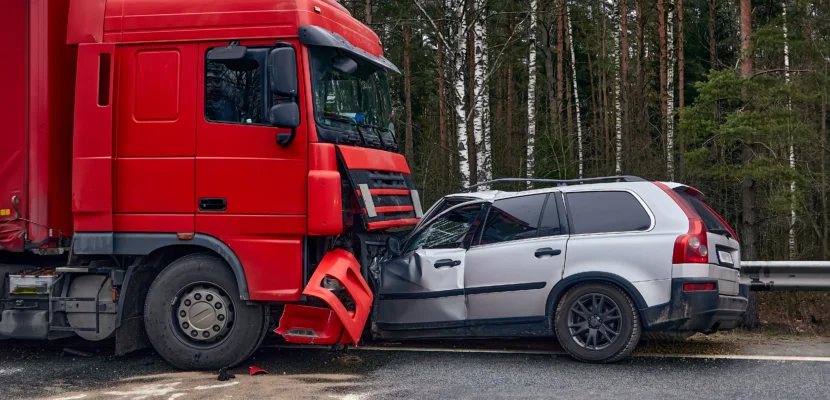
Truck no-zones are large blind spots around commercial trucks where the driver has no visibility of nearby vehicles. These four areas, spanning the front, rear, and both sides of a big rig, are recognized by federal safety agencies as zones where truck accidents are far more likely to occur.
Why Blind Spots Around Trucks Are So Large
Passenger vehicles have blind spots, too, but a big rig operates on a completely different scale. The cab’s height, the trailer’s length, and the absence of a rear window combine to create areas of zero visibility on all sides. Because commercial truck drivers rely entirely on side mirrors rather than a rearview mirror, big rigs have a large blind spot that can span multiple highway lanes. Even upgraded mirror systems and camera assists cannot fully eliminate these gaps.
These blind spots exist not because drivers are inattentive, but because the vehicles themselves create unavoidable visibility gaps. Even an attentive driver performing frequent mirror checks can miss a vehicle that enters a blind spot between glances. Add fatigue or adverse weather, and the risks multiply. That is why avoiding these zones, rather than relying on the truck driver to spot you, is the safest approach.
What Are No Zones and Where Are They Located?
No zones are high-risk blind-spot areas around commercial trucks. Here is where each one is located:
- Right-side no zone: The largest blind spot, running the full length of the trailer and often covering two or more lanes. Vehicles traveling here may be entirely out of the driver’s line of sight.
- Left-side no zone: Smaller than the right side but still substantial, running along the trailer from about the driver’s door back. A vehicle matching the truck’s speed here can disappear completely from the mirror view.
- Front no zone: Extends roughly 15 to 20 feet directly ahead of the cab. The elevated driving position means smaller vehicles cutting in too closely become invisible to the driver.
- Rear no zone: Reaches approximately 30 feet behind the trailer. Unlike passenger vehicles, commercial trucks have no rearview mirrors, leaving the entire area a blind spot.
If you are in any of these four positions, the truck driver may be unaware of your presence.
Why Truck No Zones Are So Dangerous
The danger of a truck no zone comes down to a basic mismatch: a fully loaded commercial truck can weigh up to 80,000 pounds, yet the driver may have no visibility of a much smaller vehicle right next to them. According to the National Highway Traffic Safety Administration (NHTSA), 5,472 people died in large truck crashes in 2023, and 70% of those fatalities were occupants of other vehicles, not the truck itself.
According to the FMCSA Large Truck Crash Causation Study, 14% of large truck collisions involve situations where the truck driver had inadequate surveillance, meaning they did not see the other vehicle before impact. Blind spot positioning is a direct contributor to this pattern.
Common Types of Blind Spot Truck Accidents
Staying inside a truck’s no zone increases the odds of several specific crash types:
- Side-impact collisions: Occur when a truck changes lanes without detecting a vehicle traveling beside it in the side no zone.
- Rear-end crashes: Happen when a driver tailgates a truck and is invisible within the 30-foot rear blind spot.
- Underride accidents: A smaller vehicle slides beneath the rear or side of a truck during a collision, often with devastating results.
- Wide-turn collisions: Trucks must swing wide before turning, creating temporary blind zones that catch nearby vehicles off guard.
Each of these crash types carries a high risk of serious injury given the size and weight disparity involved.
How to Stay Out of Truck Blind Spots
A few adjustments in driving behavior can meaningfully reduce exposure to no-zone hazards:
- Pass with purpose: Move through a truck’s no-zone on the side quickly rather than matching its speed and lingering.
- Use the mirror test: If you cannot see the truck driver’s face in their side mirror, they almost certainly cannot see you.
- Maintain the following distance: Keep at least four seconds of space behind a truck to stay out of the rear no zone.
- Avoid cutting in: After passing, allow enough clearance before merging back in front so you stay out of the front no zone.
- Watch for wide turns: When a truck signals a right turn, hold back rather than squeezing between the trailer and the curb.
Speed, Reaction Time, and No Zones
At highway speeds, a vehicle can enter and exit a truck’s blind spot in seconds. If the truck makes any lane adjustment during that window, there may not be enough time or space to avoid a truck accident. Slowing down or speeding up slightly to clear a blind spot is often the most practical move. The goal is staying in a position where the truck driver can see you, which requires actively managing your speed relative to the truck’s.
Legal Responsibility in Blind Spot Accidents
Determining fault in a truck-blind-spot accident is rarely straightforward. Truck drivers have a duty to check their surroundings thoroughly before changing lanes or turning, a responsibility backed by federal regulations requiring commercial drivers to operate with reasonable care and proper lookout. When a driver fails to monitor blind spots, that conduct can constitute negligence. Passenger vehicle drivers also share some responsibility for their positioning. Sitting in a truck’s no-zone for an extended period may be a contributing factor.
Texas handles these situations under its comparative responsibility statute, Texas Civil Practice and Remedies Code § 33.001. Fault can be divided between multiple parties, and compensation may be reduced in proportion to each person’s share of responsibility.
How Technology Is Changing Blind Spot Safety
Newer commercial trucks increasingly come equipped with cameras, proximity sensors, and lane-change warning systems. These tools have improved safety in some situations, but they do not eliminate the risk of blind spots. Equipment can malfunction, weather can reduce camera effectiveness, and drivers can become over-reliant on technology, leading them to skip visual checks. Older trucks may rely solely on mirrors. No zone risks persist regardless of what safety systems a truck carries.
What Every Driver Should Remember About Large Trucks
Large commercial trucks are a constant presence on Texas highways. Sharing the road safely comes down to one principle: stay visible. If a truck driver cannot see you in their mirrors, you are in a no zone. Move out of it. Avoid the four no zones, pass deliberately, and never assume a truck driver can see you just because you can see them.
FAQ: Truck Blind Spots and No Zones
Are There Federal Rules That Require Truck Drivers to Check Blind Spots?
Yes. The Federal Motor Carrier Safety Regulations (49 CFR Part 392) require commercial drivers to maintain proper control and lookout at all times, including checking mirrors before lane changes and turns. Failing to do so can constitute a violation of federal safety standards.
Can I Still Recover Compensation if I Was Partially in a No-Zone When the Accident Happened?
Possibly. Texas uses a modified comparative responsibility system. You can recover damages as long as your share of fault does not exceed 50%. If it does, recovery is barred. If it is at or below 50%, your compensation is reduced by your percentage of fault. How no zone positioning factors into a specific case depends on the full accident circumstances.
What Evidence Proves Which Part of a Truck I Was Next To During a Crash?
Crash reports, traffic camera footage, witness accounts, and black box data from the truck can all help establish the truck’s position at the time of impact. When positioning is disputed, accident reconstruction specialists are sometimes brought in to piece together the sequence of events.
Do No Zones Apply to Other Large Vehicles Besides Semi-Trucks?
Yes. Buses, dump trucks, garbage trucks, and other large commercial vehicles have comparable blind spots due to their size and limited rearward visibility. The dimensions vary, but the principle holds: the larger the vehicle, the more significant its no zones.
What Should I Do if a Truck Changes Lanes Into Me Because of a Blind Spot?
If you see a truck beginning to drift into your lane, tap your horn, increase your speed to move ahead, or slow down to drop behind the truck’s trailer to get out of the no-zone immediately.
If a collision does occur, get to safety first, then document the scene with photos and call 911 to file a police report. Collect the truck driver’s name, commercial license number, and the motor carrier’s information. Seek medical attention even if injuries seem minor, since symptoms can appear hours or days later. Preserve any dashcam footage and avoid making statements to insurance representatives until you have legal guidance.
Injured in a Truck Blind Spot Crash? Call Mokaram Injury Lawyers
If a truck driver’s failure to check their no zones left you injured, you should not have to handle the legal and insurance process alone. At Mokaram Injury Lawyers, we are available around the clock, including after hours and weekends. Every client gets direct attention, not hand-offs.
Call our office at (281) 222-2222 or contact us online for a free case review. There is no cost to speak with us, and no fee unless we recover for you.